A phone app that explains official messages out loud
Bills, mobile money SMS, letters from the hospital or the school. Take a photo or paste the text, and SabiTori says who sent it, what to do, by when and how much. If it looks like a scam, you hear that first.
Free. Works with no internet. Android 7 or newer, iPhone coming. French and English today.
The pilot build installs from GitHub, not from the Play Store.
How SabiTori explains a message
Small models on the phone read the message and sort it. Plain code then finds every date, amount and phone number, and checks each one against the message itself.
-
Show it the message
Take a photo of a paper or a screen, or share or paste an SMS.
-
Get a card
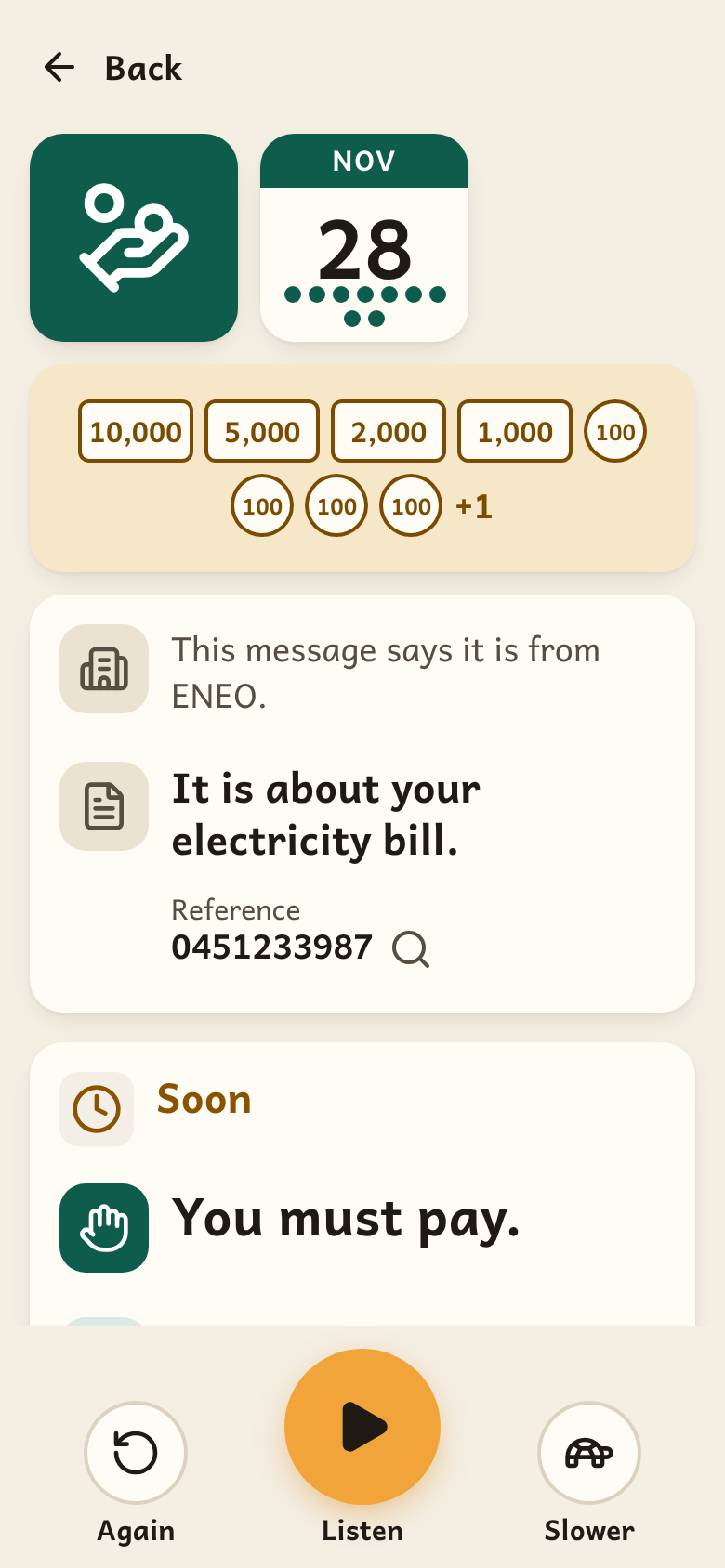
Who sent it, what it is about, what you must do, by when, how much, and who to call.
-
Listen to it
The card is spoken part by part. Tap an amount or a date to see where it is in the message.
When SabiTori is unsure what a message means, it shows only the facts it found, and says so.
The app in one minute
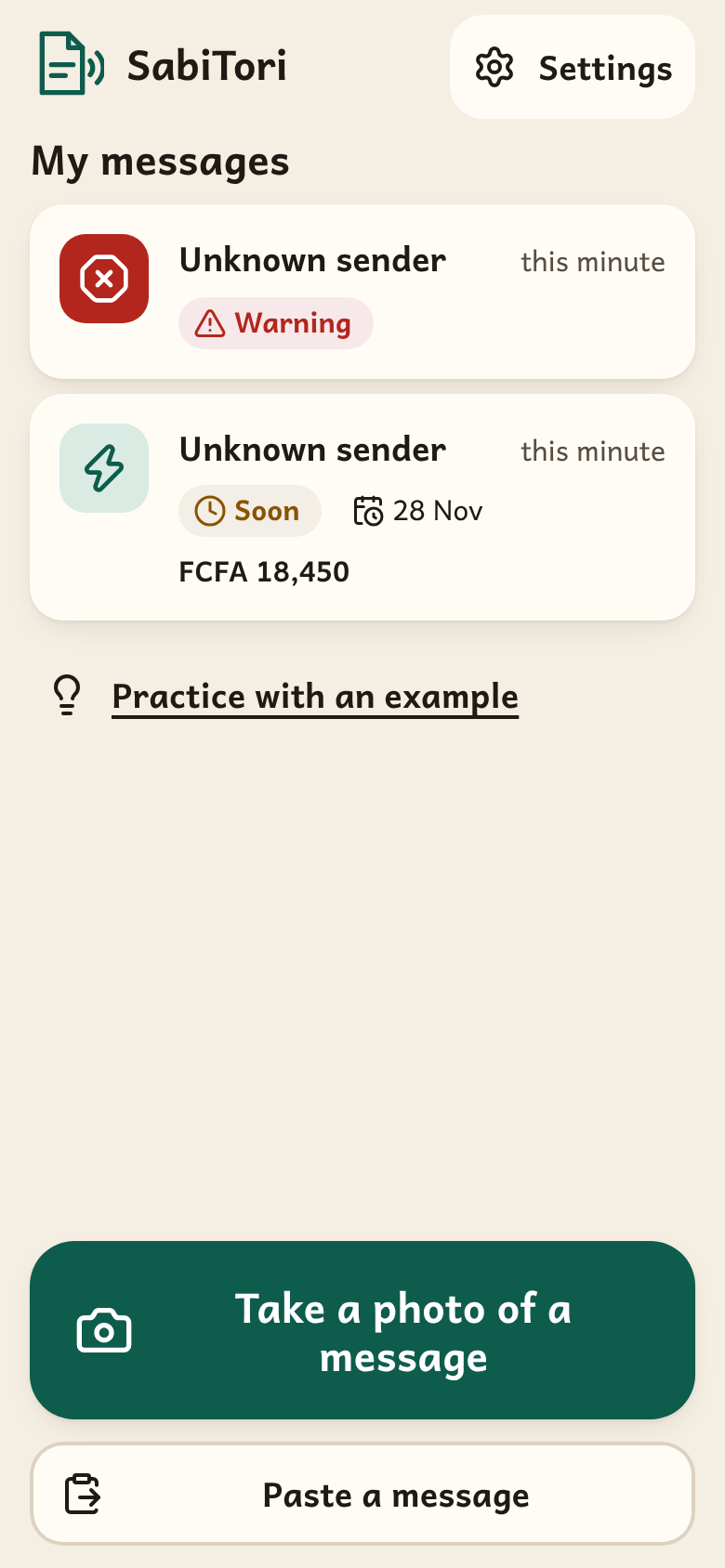
A screen recording of SabiTori explaining three messages:
- a French electricity bill, pasted and explained in English;
- a mobile money SMS that gets a scam warning before anything else;
- a photo of a paper bill, read on the device.
Recorded from the app running in a desktop browser at phone size, not on a phone. The wait while the photo is read is shortened by about 3 seconds.
Scam warnings come first
When a message looks like a trick, SabiTori says so before anything else and gives its reasons. The warnings come from written rules in code, not from the model, so anyone can check why one appeared.
A practice message from the app
650 55 66 77
Vous avez reçu 25 000 FCFA de Jean Paul. Il s’agit d’une erreur, merci de me renvoyer l’argent immédiatement. Appelez-moi vite au 650 55 66 77.
SabiTori never calls a message safe. When it finds nothing, it says: We found no warning signs. Never share your PIN with anyone.
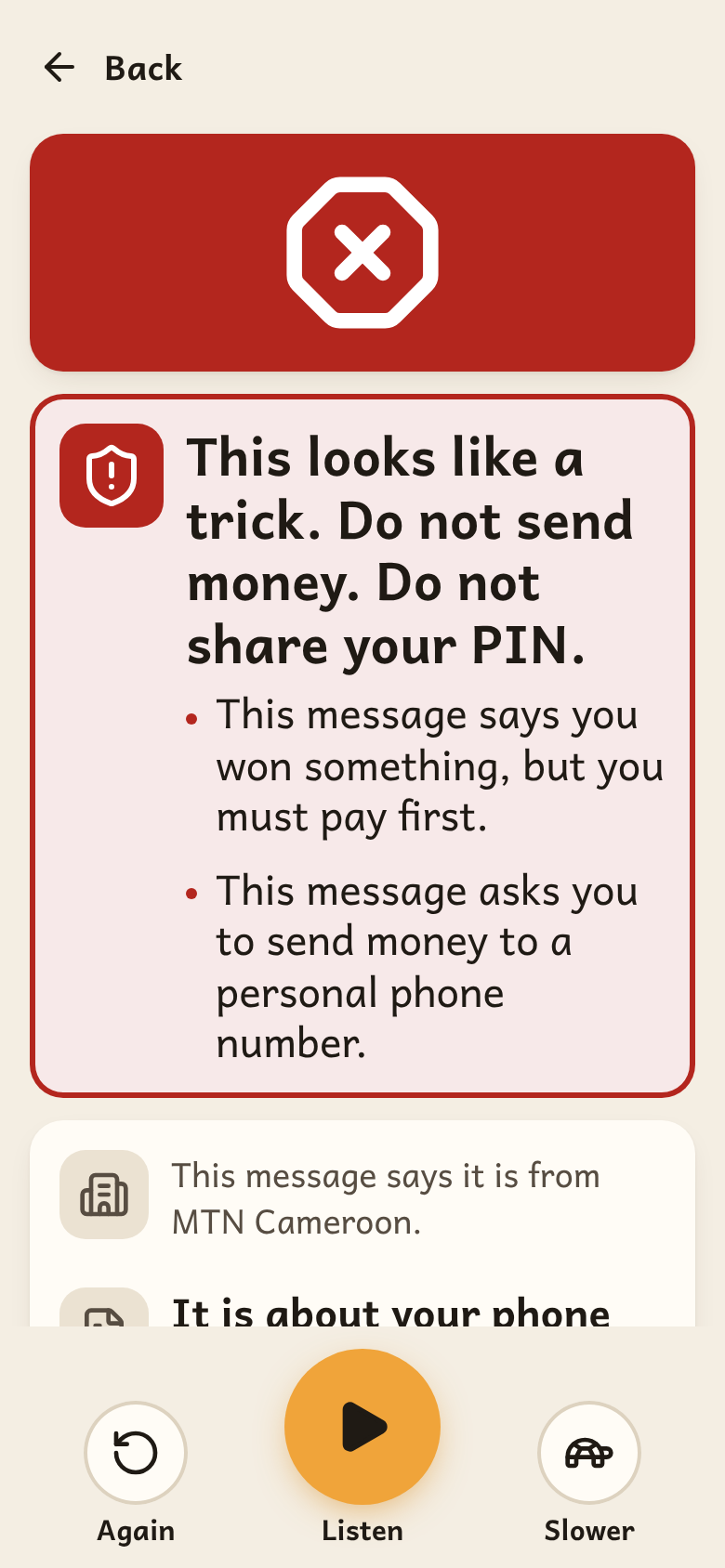
This looks like a trick. Do not send money. Do not share your PIN.
- This message pushes you to act very fast.
- This balance message does not come from your operator.
- This message asks you to call a number. Use the official number instead.
Check your balance with your operator’s own code, not with a number from this message.
Spoken by your browser’s voice here. In the app, by the voice in the language pack.
The tricks SabiTori warns about
The common mobile money and SMS tricks, each with the sentence the app says.
- A prize you must pay to receive
This message says you won something, but you must pay first.
- Money to send to a personal number
This message asks you to send money to a personal phone number.
- A fake “you received money” SMS
This balance message does not come from your operator.
- A request for your PIN
This message asks for your secret code.
- An offer to double your money
This message promises your money will grow fast. This is a common trick.
It also warns about links, threats to block your SIM, codes to dial, and messages that claim a company name from an ordinary number.
Who SabiTori is for
People an official message leaves out: because of reading, sight, hearing, or the language it is written in.
- People who cannot read well
- Every card is spoken. With “Listen first” on, a button says its name on the first tap and acts on the second. The text is set in Andika, a typeface made for beginning readers.
- People who are blind or have low vision
- Built to work with TalkBack. Each new screen puts focus on its title, and text grows to 200 % with nothing going off the screen.
- People who are deaf or hard of hearing
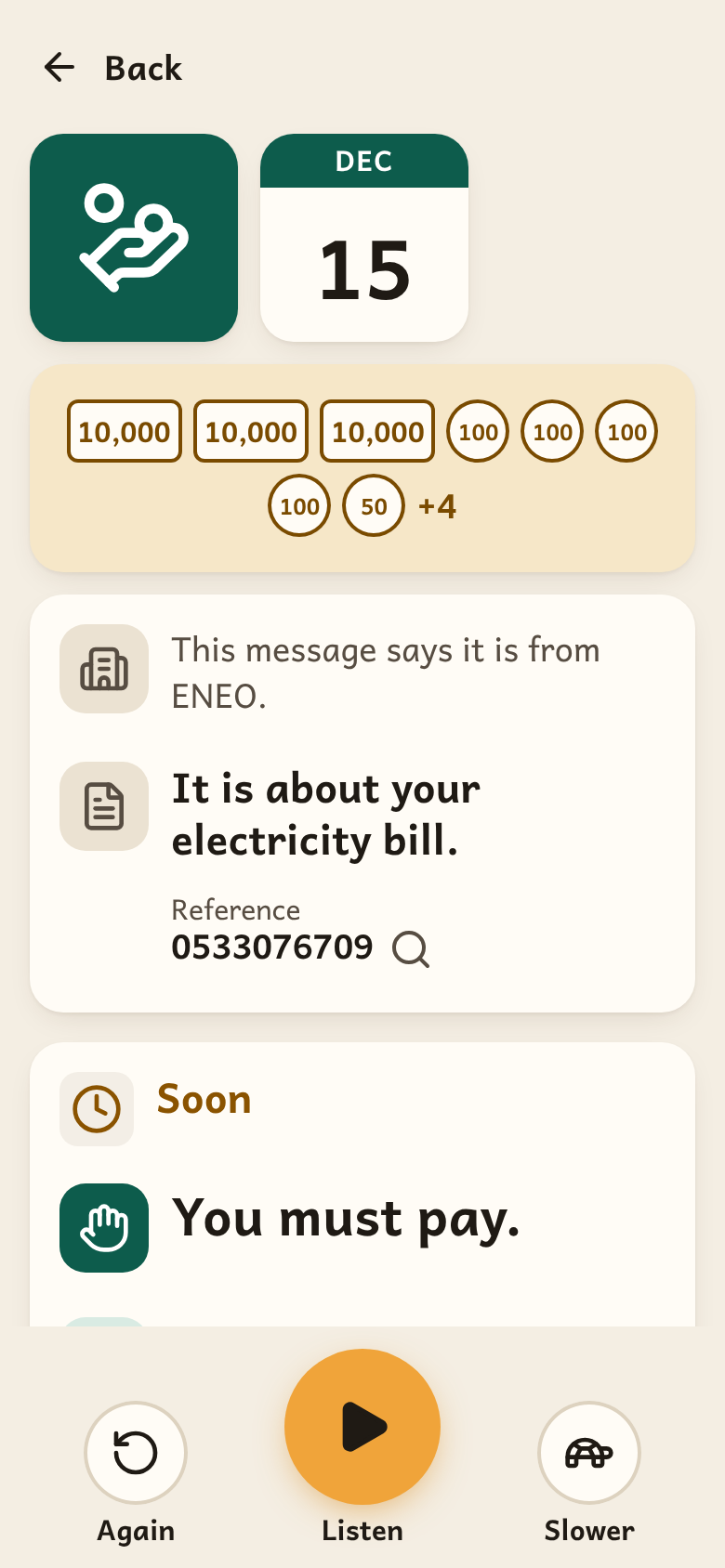
- Every spoken card is also written, and urgency is a colour, an icon and a word. Each card also opens with a picture card: what to do as a symbol, the deadline as a calendar page, the amount as notes and coins. A likely scam shows a stop sign and makes the phone vibrate.
- People who do not speak the message’s language
- A message in French can be explained in English. Cameroonian languages follow as their speakers record them.
No blind, low-vision, deaf or non-reading person has tested SabiTori yet. Automated checks find no known barrier; testing with disabled people is the first job of the pilot.
Your messages never leave your phone.
SabiTori reads, understands and speaks on the phone itself. It works in airplane mode.
There is no account and no sign-in. There are no ads and no analytics.
Updates and error reports are off by default. If you switch them on, they never carry your messages.
It is free for everyone, with no paid tier and no sale of data, and it stays that way.
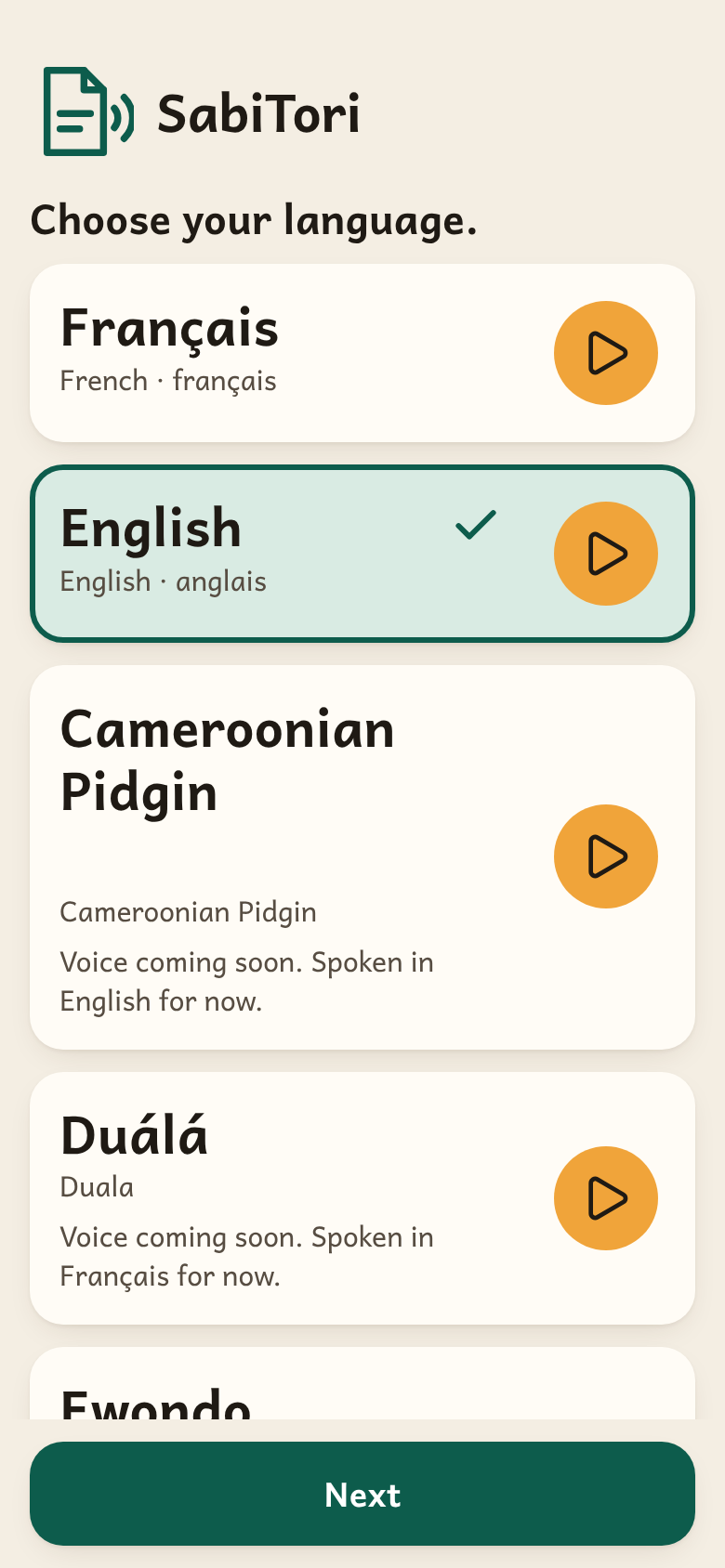
French and English today. Cameroonian languages next.
SabiTori means “understand the story” in Cameroonian Pidgin. Every word it says comes from a language pack, so a new language needs no change to the code.
- Cameroonian Pidgin
- Duala
- Ewondo
- Adamawa Fulfulde
- Lamnso’
- Limbum
- Pinyin
These seven are set up in the app and waiting for native speakers. Until their voices are recorded, each one speaks its fallback language and says so.
Two speakers record a language in 2 to 4 days with the Recorder app: about 70 short sentences and 60 number words. Each gives written consent, chooses how their voice may be used, and is paid for every session.
Our test numbers, with their limits
All messages and photos are synthetic, written or rendered for testing. No real message has been evaluated yet, and nothing here was measured on a phone. There has been no pilot and there are no users yet.
| What was tested | Result | Conditions |
|---|---|---|
| Scam warnings | 18 of 21 scams warned; 2 of 79 genuine messages falsely warned | Unseen set of 100 synthetic messages, never used for tuning |
| Understanding a message (kind, action and urgency all right) | 49.0% [39.0–58.0], against 36.0% [27.0–45.0] for rules alone | Same unseen set; +13.0 points, p = 0.024 (exact McNemar test); brackets are 95% bootstrap intervals |
| Reading photos on the phone | 84.3% of dates, amounts and phone numbers recovered; 97.5% of those read are right; every fact right on 20 of 30 pages | 30 degraded synthetic photos of bills, letters and SMS screenshots |
| Time from a pasted bill to a card | 1.3 to 2.3 s | Desktop CPU slowed 4x as a slow-phone stand-in, not a phone |
| Size of the understanding model | 32.6 MB (int8, 33 M parameters) | Runs on the phone, offline |
| Accessibility checks | 163 screen states, 0 violations | WCAG 2.2 AA (axe-core) plus manual-class checks; no disabled person has tested the app yet |